Because this ETC is a prototype, we are not transitioning any real communities. Our communities will be a sandbox based on relative data that will help inform real communities what the transition impact may look like.
The sandbox is currently exploring three variants:
- The island community is physically isolated and exists without road or rail access to other communities.
- The state community is physically connected to other communities via road and rail, but still operates under an independent governance.
- A continental community has governance over multiple state communities and has connections to global systems.
Transition Goals
A transition is considered successful when all community members are able to sustainably access their needs without debt. Not all modern amenities are required for a successful transition, and all communities will need to balance the benefits and costs of all necessary systems.
TBD
Further Equity System explorations are necessary before proposals are adopted into the Community Equity System Catalog.
TBD
Membership Ledger
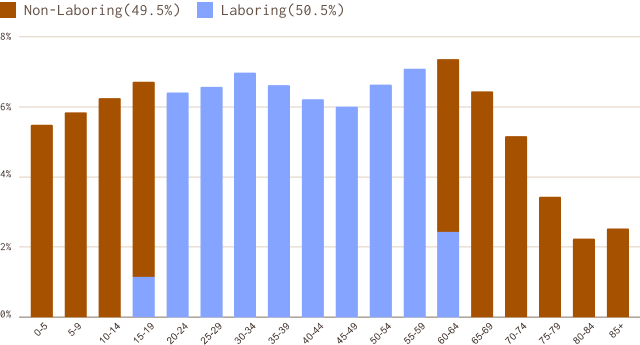
This community assumes a population of ten million (10,000,000) people. With the following age breakdown. Age will be used to determine how many people are expected to be retired, and the CLO for the laboring population.
Age and Labor
Life Expectancy
This community assumes a life expectancy of 75 years for all members. In reality men will have a lower life expectancy on average, and each generation will have a different life expectancy.
The LLO of all members in this community is (LE/2) 37.5 years. This community assumes all members will only perform the CLO, and no additional hours. Thus all community members will start laboring at 18 and retire at 55.5 years old.
Economic Asset Ledger
Locations
This sandbox community is based on the land of Pennsylvania. Existing structures are assumed, but may change purpose and function.
- Area: 119,279 km² (46,054 sq mi)
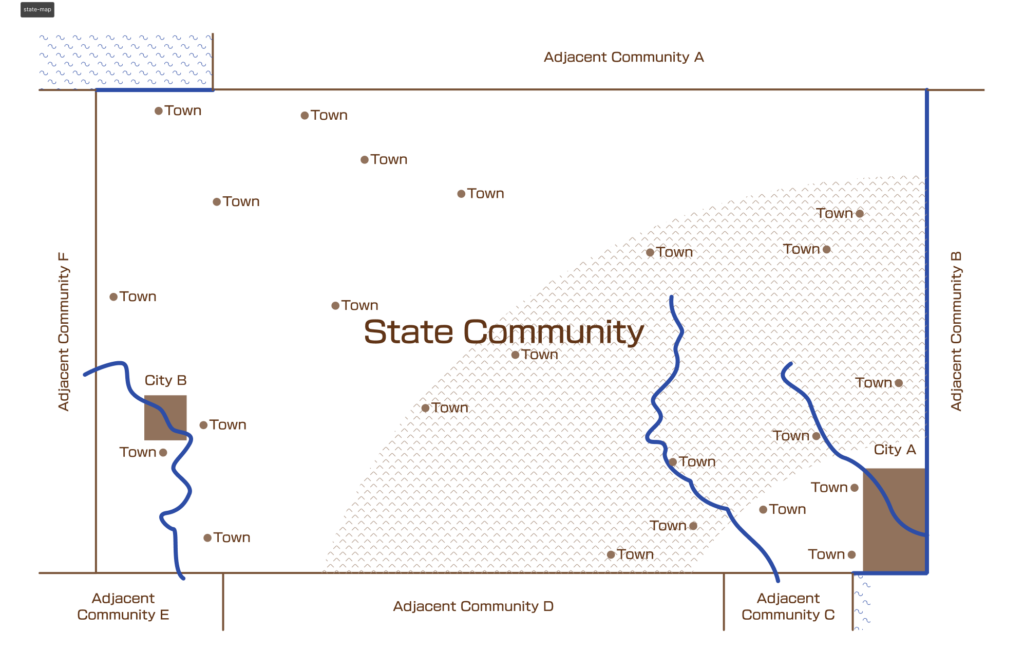
State Community has two major cities with urban infrastructure and smaller pockets of developed towns. Most of the land is rural with a sparse network of towns and boroughs. The Appalachian Mountains sweep through most of the land creating a lot of valleys and rolling hills. There is river access throughout the community providing water to most areas.
There are 4.0 million occupied residential units. 3.0 million are occupied by their owner. 1.0 million are occupied by renters. The average household size is 2.5 people.
Labor
- Education & Health Services: 20.5%
- Trade, Transportation, and Utilities: 16.3%
- Professional & Business Services: 12.1%
- Government: 10.1%
- Leisure & Hospitality: 8.5%
- Manufacturing: 8.1%
- Agriculture: 6.5%
- Financial: 5.0%
- Unemployed: 3.8%
- Construction: 3.8%
- Other Services: 3.8%
- Information: 1.2%
- Mining & Logging: 0.3%
Resources
- Farmland
- 7,000,000 acres
- src
- Water Sources
- Delaware
- Susquehanna
- Potomac
- Ohio
- Erie
- Genesse
- src
- Minerals
Information
- Data
- Community Data
- Published Data
- Standards
- Regulations
- Processes
Further Equity System explorations are necessary before proposals are adopted into the Community Equity System Catalog.
Membership Impact
This process assumes 100% transition registration with no immigration. This transition will impact ten million people. All unemployed members (3.8%) will be first priority towards labor opportunities. All unhoused members (0.7%) will be first priority towards shelter opportunities.
Residential Impact
Residential Impact is governed by the Residential Structure Distribution Process.
- Unimpacted Members: #,###,###
- Members who are either currently living in a residence that meets sustainability standards, or are electing to maintain living in a residence that does not meet sustainability standards.
- Residence Priority Members: #,###,###
- Members who are either unhoused, living in a rented residence the original owner has elected to maintain as their residence, or living in a residence that currently does not meet sustainability standards and are electing to modify the current residence, or change to a sustainable residence.
- These members will have first priority towards selecting a residence that meets sustainability standards.
Members are allowed to change residences after transition, but all residences that can be maintained should be for better transition efficiency.
Transition Modifications
- Existing residences may be retrofitted to increase private residence occupation, allowing the structure to fall under sustainability.
- Existing residences that do not meet sustainability standards will not be demolished, unless it falls vacant for an defined period of time after transition.
- Existing unoccupied residences that do not meet safety standards will be demolished and the land will be reappropriated.
Labor Impact
- Unimpacted Members: #,###,###
- Members who are currently working in a business that will be transitioned into a Necessary Cooperative, and are not immediately at risk of labor automation. These members will maintain their current labor obligations.
- Labor Priority Members: #,###,###
- Members who are either currently working in a business that will be transitioned into an Unnecessary Cooperative, currently unemployed, or at immediate risk of labor automation .
- These members will have first priority to establish a labor obligation with a Necessary Cooperative.
- Labor Exempt Members: ###,###
- Members, at the time of transition, who would be of age to have fulfilled their Lifetime Labor Obligation at the current Cycle Labor Obligation.
- Members who are either under age to sign an independent Community Equity Contract, or are medically cleared to have their CLO amended or suspended.
Members are allowed to change labor obligations after transition, but all labor obligations that can be maintained should be for better transition efficiency.
Economic Impact
Location Impact
All locations (land and structures) will be classified as a:
- Private Residence
- This location is under the responsibility of a community member and functions as their private residence. While the community member cannot claim ownership of this location, they do have a right to privacy within the location. Ability to modify the location is dependent on Shelter and Infrastructure Regulations of the community.
- There are #,###,### listed private residences.
- Private Coop
- This location is under the responsibility of a cooperative and the coop members. While the coop cannot claim ownership of this location, they do have a right to securely maintain the location. Community members do not have a right to access these locations in order to access their needs.
- There are ###,### listed private coop locations.
- Public Coop
- This location is under the responsibility of a cooperative and the coop members. Community members also have a right to access this location in order to access their needs.
- Parks, walkways, and spaces that allow uninterrupted public access fall under this category as they would still be the responsibility of an infrastructure cooperative.
- There are ###,### listed public coop locations.
Labor Impact
Labor sectors will be reorganized based on the Necessary System map. Not all existing labor positions may be necessary, even if your labor sector is prioritized. Labor transitions will happen in every system. Please read each labor sector report to see labor breakdown and transitions.
The first priority for labor assignment is proximity to residence. Decreasing commuting time increases personal time, which directly improves quality of life. The process and prioritization of labor assignment is regulated by the Labor Coordination Committee.
All private/public/government organizations will become labor cooperatives, with no ownership structure, and equitable representation. There are around 1.2 million individual businesses. 99.6% are small businesses, but only occupy half of the labor force. The other 0.04% of businesses, that employ the other half of people, are large national/international businesses.
Resource Impact
- Organic Material will be produced, maintained, and serviced by Agriculture Cooperatives.
- Water will be produced, maintained, and services by Water Cooperatives.
- Minerals and Lumber will be produced, maintained, and serviced by Infrastructure Cooperatives.
Sustainability and Equity are the two priorities when laboring towards and accessing resources.
Imports and Exports
Pennsylvania (sandbox) is able to produce and service most of it’s food and minerals internally. Most imports are from globalized resources including, but not limited to:
- Medical resources (vaccines, blood, antisera, cultures, etc.)
- Packaged medicaments
- Computers
- Cars
- Telephones
Globalized assets will require additional labor obligations. The Multi-Community Asset Process will define the equitable exchange of labor and resources in order to access globalized resources.
Information Impact
All information systems will become publicly accessible. Libraries will become the primary physical location to access published information. Personal information technology will be equitably accessible. Information produced on personal information technology is private information.
Information will be maintained and serviced by Information Technology Cooperatives.
Ownership System Sunsetting
Once all community members and economic assets have been accounted for, then all ownership systems listed below can cease operations without any impact on the transition or maintenance of the necessary systems.
Ownership Rights
All entitlement to ownership over any person or economic asset will become null and void. This includes private ownership, public ownership (shareholders), and community ownership (government). No claim of ownership after community transition will be honored or enforced. All community members are responsible for the equitable access towards all necessary systems within the community.
Private access towards a personal residence does not include ownership over the structure. If your residence does not meet safety regulations or sustainability standards, you may lose access to that specific residence. You cannot sell or trade your residence for inequitable access.
Taxes & Currency
All entitlement to taxes over any person or group will become null and void. The value of any currency issued by the community or individual will become null and void. All labor and assets that produce, maintain, or service taxes, currency, and debts will cease operations and be reprioritized.
Other Financial Systems
All other financial systems that depend or service currency or debts will cease operations and be reprioritized. This includes, but is not limited to: bail, stocks, bonds, loans, gambling, etc.
TBD
Further Equity System explorations are necessary before proposals are adopted into the Community Equity System Catalog.
TBD